
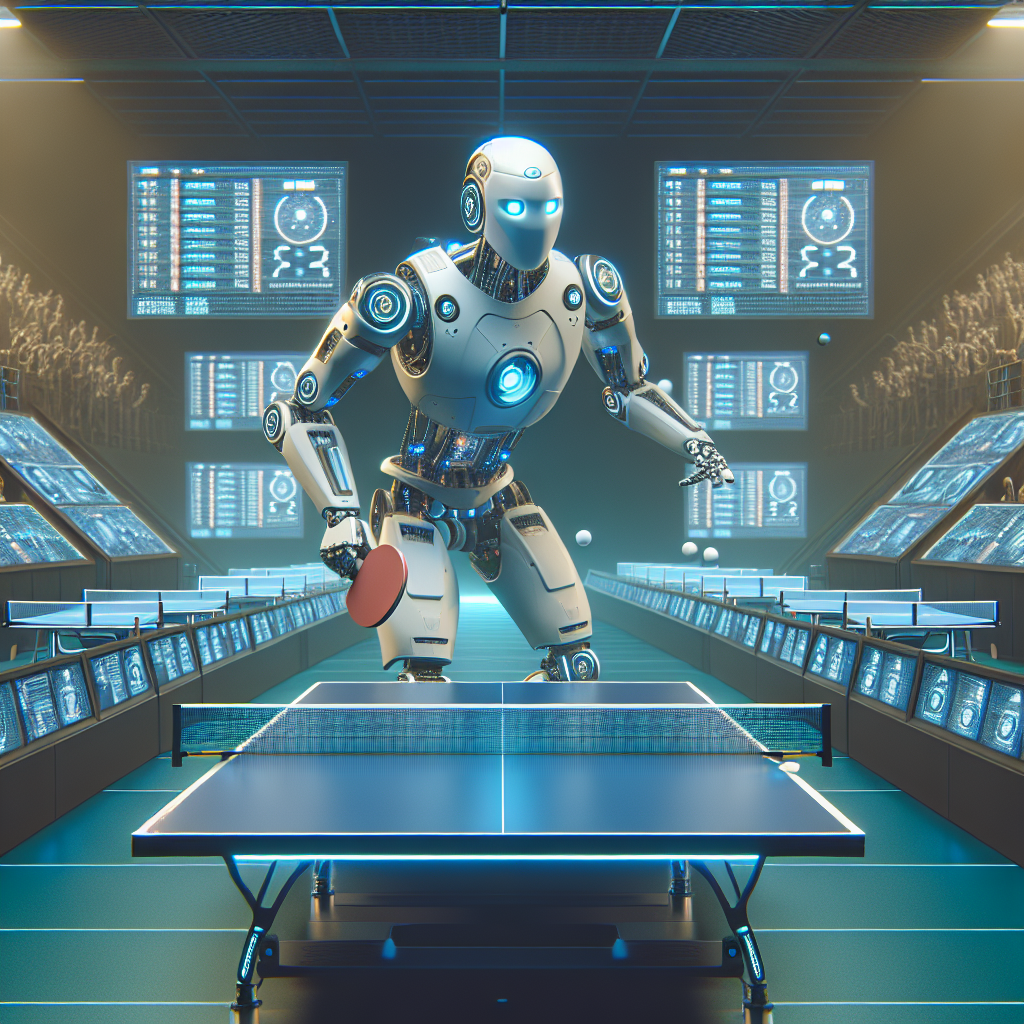
An innovative AI-driven robot, developed by Sony, is setting new benchmarks in the world of table tennis by challenging and even defeating some of the game’s elite players. Known as Ace, the robot combines artificial intelligence with sophisticated sensors and a highly flexible arm to compete under official table tennis rules.
In a breakthrough reminiscent of the 1997 chess match where Deep Blue defeated Garry Kasparov, Ace symbolizes a significant leap in AI capabilities. Unlike previous AI achievements in games like chess and Go, Ace’s triumphs occur in the physical realm, showcasing its potential to revolutionize sports.
According to Peter Dürr, the leader of the Sony AI team in Zurich, Ace represents an unprecedented fusion of robotics and athleticism. The robot excels through three key technological advancements. Firstly, it employs event-based sensors, allowing it to focus on crucial changes in motion and brightness to track the ball’s trajectory accurately.
Secondly, Ace’s skills are honed using a model-free reinforcement learning approach, where it gains expertise through extensive simulation rather than relying on predefined rules. This approach enabled Ace to accumulate thousands of hours of virtual practice, translating into remarkable agility and speed on the table.
Finally, Ace’s hardware boasts unmatched responsiveness, reacting in just 20 milliseconds—far quicker than the 230 milliseconds typically required by human athletes. This speed advantage allows Ace to compete on par with human players, even surpassing them in some aspects.
Despite its mechanical appearance and reliance on an array of cameras and sensors, Ace has already achieved significant victories. In recent competitions, it faced experienced players from the Japanese professional league, securing wins against both elite and professional opponents.
Ace’s achievements go beyond technical prowess. It introduces a new dynamic to the game by eliminating human tells while simultaneously learning to interpret opponents’ spins and movements. Its adaptability even surprised the developers when Ace successfully returned balls deflected by the net, a skill not explicitly programmed.
As Ace continues to evolve, the team envisions a future where it might adopt a more humanoid form, further enhancing its capabilities. With ongoing improvements, experts, including former Olympian Kinjiro Nakamura, anticipate that Ace could soon outperform even the reigning world champion, inspiring human athletes to adopt new techniques.
The journey of Ace is a testament to the rapid advancements in AI and robotics, promising a future where machines and humans coexist in competitive sports, pushing each other to new heights.
Leave a Reply