
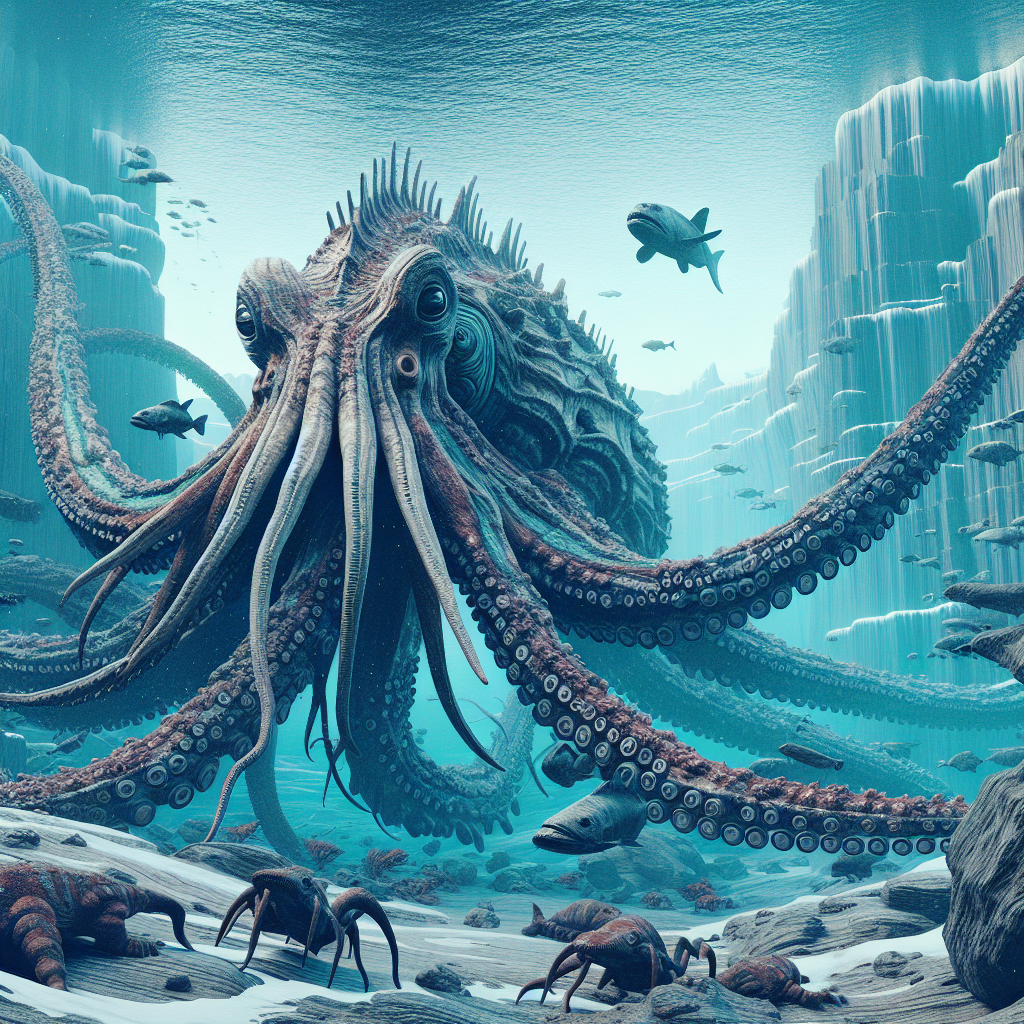
In an extraordinary revelation, scientists have unearthed evidence of gigantic octopuses that dominated the oceans during the Cretaceous period, suggesting these invertebrates were formidable predators of their time. Fossil remains indicate that these octopuses stretched up to 19 meters in length, rivaling the size of the era’s top marine predators such as sharks and marine reptiles.
Yasuhiro Iba, a researcher at Hokkaido University in Japan, likens these ancient octopuses to the orcas and great white sharks of today, highlighting their size, intelligence, and predatory efficiency. “These creatures, some exceeding 10 meters, were equipped with extensive arms and robust jaws, allowing them to crush hard-shelled prey,” Iba explains.
The discovery is based on the analysis of 27 large, fossilized octopus jaws found in Japan and Canada, with a dozen recognized as new to science. These fossils were extracted from rock using advanced scanning and digital techniques, showcasing the potential of technology in paleontological research.
Previously, only five species of Cretaceous octopuses were known, but Iba’s team has confirmed two: Nanaimoteuthis jeletzkyi and N. haggarti. Remarkably, the jaw size of N. haggarti suggests a potential length between 6.6 to 18.6 meters, marking it as one of the largest known invertebrates.
According to John Long of Flinders University, this finding aligns with a period of gigantism seen in various marine species, including sharks and ammonites. Yet, he describes the notion of “giant killer octopi” as a shocking discovery, reshaping our understanding of Cretaceous marine life.
These ancient octopuses bore some resemblance to modern giant squids, but with notable differences. Unlike squids, which use tentacles for capturing prey, these octopuses relied on their eight arms, likely using them to grasp and process prey with their powerful jaws.
The team found signs of significant wear on the jaws, indicative of processing hard materials such as bivalves and ammonites. Although there’s no direct evidence of them preying on marine reptiles, the wear patterns suggest they were adept at handling sturdy prey.
Intriguingly, the asymmetric wear of the jaws hints at lateralization, a trait associated with intelligence, suggesting these octopuses may have demonstrated complex behaviors akin to modern octopuses.
Leave a Reply